The EPSO AD7 ICT Project Management competition (EPSO/AD/429/26, Field 2) selects experienced ICT project managers at grade AD7 to run digital projects inside the European Commission and the other EU institutions. The decisive stage is a field-related test of 30 scenario questions in 40 minutes, and it draws on a broad syllabus. This guide maps that syllabus in full: the 14 modules, the five themes they group into, and how to use the map to plan your revision.
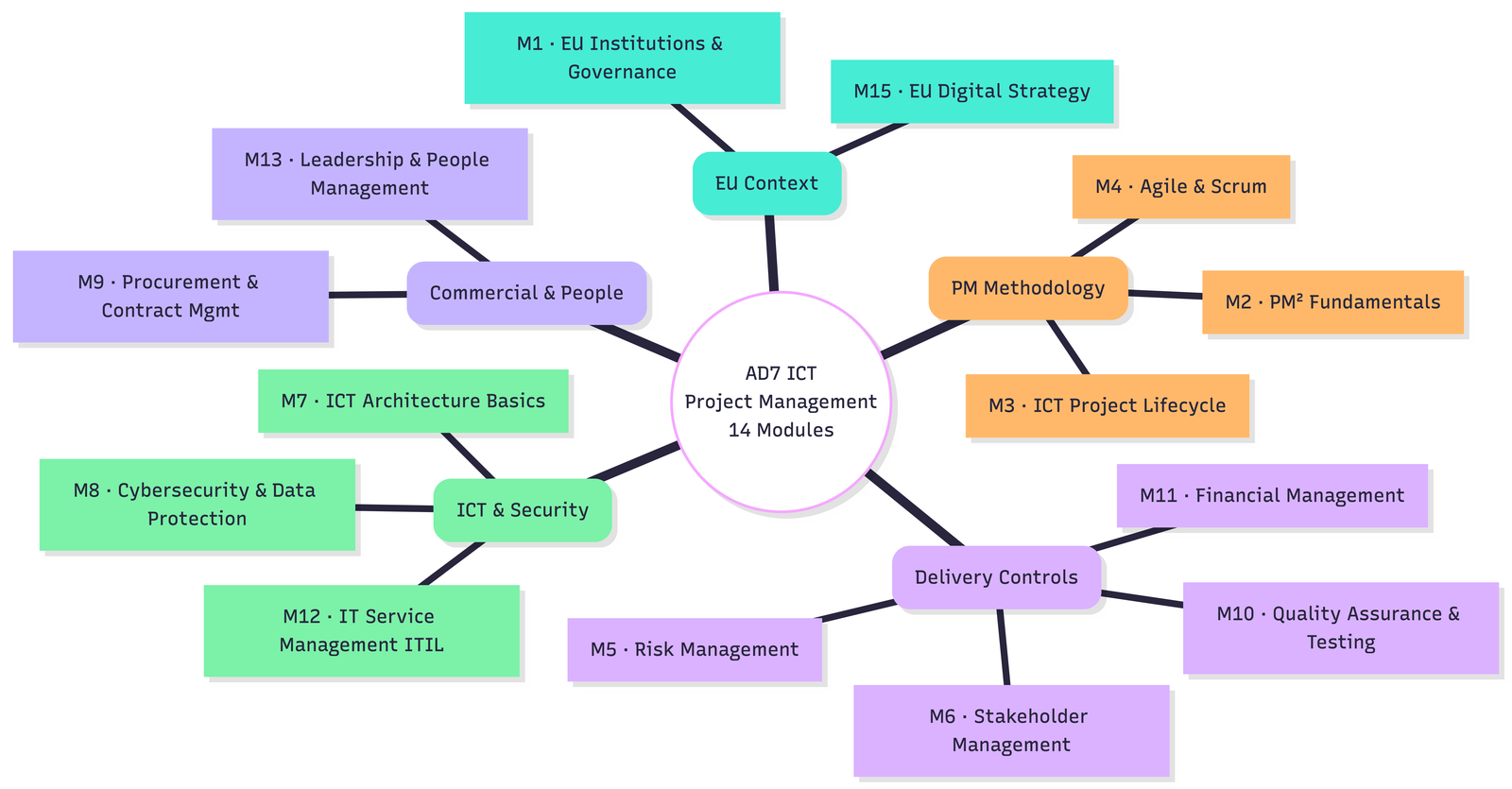
The 14 modules at a glance
Every module is examinable. The table below lists all 14 and the theme each belongs to, so you can see the shape of the syllabus before diving into any one area.
| Module | Theme | Core focus |
|---|---|---|
| M1 · EU Institutions & Governance | EU Context | The institutional triangle and how decisions are made |
| M2 · PM² Fundamentals | PM Methodology | The Commission's own PM methodology: phases, roles, artefacts |
| M3 · ICT Project Lifecycle | PM Methodology | Waterfall, Agile, hybrid and DevOps, and when each fits |
| M4 · Agile & Scrum | PM Methodology | Roles, events and artefacts; Agile within PM² governance |
| M5 · Risk Management | Delivery Controls | Risk registers, assessment and mitigation |
| M6 · Stakeholder Management | Delivery Controls | Mapping and managing institutional stakeholders |
| M7 · ICT Architecture Basics | ICT & Security | Application, integration and interoperability foundations |
| M8 · Cybersecurity & Data Protection | ICT & Security | Reg. (EU) 2018/1725, the EDPS, NIS2 and security-by-design |
| M9 · Procurement & Contract Management | Commercial & People | Financial Regulation, framework and specific contracts |
| M10 · Quality Assurance & Testing | Delivery Controls | Test strategy, acceptance and quality gates |
| M11 · Financial Management | Delivery Controls | Budgets, appropriations and earned-value basics |
| M12 · IT Service Management (ITIL) | ICT & Security | Incident, problem and change management; SLAs |
| M13 · Leadership & People Management | Commercial & People | Leading teams and managing performance |
| M15 · EU Digital Strategy | EU Context | The Digital Decade, the AI Act and digital sovereignty |
Theme 1 — EU Context
Everything on this exam is framed inside the EU institutions, so the syllabus opens and closes with the EU dimension. This theme is the differentiator: a candidate can be a strong project manager and still fail here.
- M1 · EU Institutions & Governance — the Commission, Parliament and Council, the role of DG DIGIT as the owner of PM², and how a project fits the institutional decision-making chain.
- M15 · EU Digital Strategy — the Digital Decade targets, the AI Act, interoperability and digital sovereignty, and how they shape what EU ICT projects are asked to deliver.
Theme 2 — PM Methodology
The methodological core of the exam. Most questions rest on PM² and on choosing the right delivery approach, so this theme carries the heaviest weight and is the right place to start your revision.
- M2 · PM² Fundamentals — the European Commission's own methodology, published by DG DIGIT. Know its four phases, its governance roles (Project Owner vs Project Manager) and its key artefacts.
- M3 · ICT Project Lifecycle — Waterfall, Agile, hybrid and DevOps delivery, and the judgement to pick the right one for a given scenario.
- M4 · Agile & Scrum — Scrum roles, events and artefacts, and how Agile coexists with PM² governance under Agile PM².
Theme 3 — Delivery Controls
The disciplines that keep a project on track once it is running. These modules are where PM technique meets EU budget rules, and they generate a lot of scenario questions.
- M5 · Risk Management — identifying, assessing and mitigating risk, and maintaining a risk register.
- M6 · Stakeholder Management — mapping and managing the many institutional stakeholders around an EU project.
- M10 · Quality Assurance & Testing — test strategy, acceptance criteria and the quality gates that a delivery has to pass.
- M11 · Financial Management — project budgeting, the crucial distinction between commitment and payment appropriations, and earned-value basics (PV, EV, AC and the CPI/SPI indices).
Theme 4 — ICT & Security
The technical spine that an ICT project manager must be able to reason about — not as an engineer, but well enough to make sound decisions and hold suppliers to account.
- M7 · ICT Architecture Basics — application, integration and interoperability foundations for EU systems.
- M8 · Cybersecurity & Data Protection — Regulation (EU) 2018/1725 (the institutions' data-protection rules, supervised by the EDPS — not the GDPR), the NIS2 Directive, and data-protection-by-design and DPIAs at initiation.
- M12 · IT Service Management (ITIL) — incident, problem, change and configuration management, and SLAs, for the run phase after go-live.
Theme 5 — Commercial & People
The two modules that surround delivery on either side: how you buy what you cannot build, and how you lead the people who build it.
- M9 · Procurement & Contract Management — the Financial Regulation, framework contracts and specific contracts/order forms, and why the compliant fast route is a specific contract under an existing framework, never a direct award.
- M13 · Leadership & People Management — leading project teams, managing performance and the soft skills the assessment phase probes.
How the syllabus is tested
The syllabus feeds a single, decisive paper: the field-related multiple-choice test — 30 questions in 40 minutes, pass mark 15/30. It is the only ranked test; the reasoning tests and the EU-knowledge essay are pass/fail gates, but this paper sets your place on the reserve list. There is no negative marking, so never leave a question blank.
Questions are scenario-based and test judgement, not recall. A typical item describes a delivery problem — a slipping supplier, a pending implementing act, an exhausted budget line — and asks what the project manager should do next under EU rules. That is why the syllabus is worth reading as a map of connected decisions rather than a list of topics to memorise.
How to use this syllabus to prepare
The mind map is a revision plan as much as a reference. A workable sequence:
- Start with PM Methodology (Theme 2). PM² anchors most questions — learn its phases, roles and artefacts before anything else.
- Add the EU Context (Theme 1) and the EU-specific rules inside the other themes — Reg. 2018/1725 and the EDPS, the Financial Regulation and framework contracts, NIS2. This is the layer most candidates neglect.
- Drill the calculation-heavy corner — earned value in M11 is the one place the exam can demand a number.
- Practise scenarios, not flashcards — train on "what should the PM do?" items that combine PM technique with EU law and budget rules.
- Finish with timed mocks — full 30-question, 40-minute papers to build pacing and stamina.
Prep4EU's AD7 ICT Project Management study pack follows this exact syllabus: a 14-module manual, 14 module quizzes and three 30-question mock exams (~300 practice MCQs) in the exact EPSO format, framed throughout in the EU-institutional context.
EPSO AD7 ICT Project Management syllabus: FAQ
How many modules are in the EPSO AD7 ICT Project Management syllabus?
Fourteen. They group into five themes: EU Context, PM Methodology, Delivery Controls, ICT & Security, and Commercial & People.
Which module matters most?
PM² Fundamentals (M2). It is the European Commission's own methodology and the reference point for most scenario questions, so it is the right place to begin.
Is generic (private-sector) project management enough?
No. The exam expects PM² rather than PMBOK or PRINCE2, and it layers EU-specific financial, procurement and data-protection law on top. That EU dimension is what most candidates underestimate.
What is the pass mark?
The field-related test is 30 questions in 40 minutes with a pass mark of 15/30. It is the only ranked stage, and there is no negative marking.